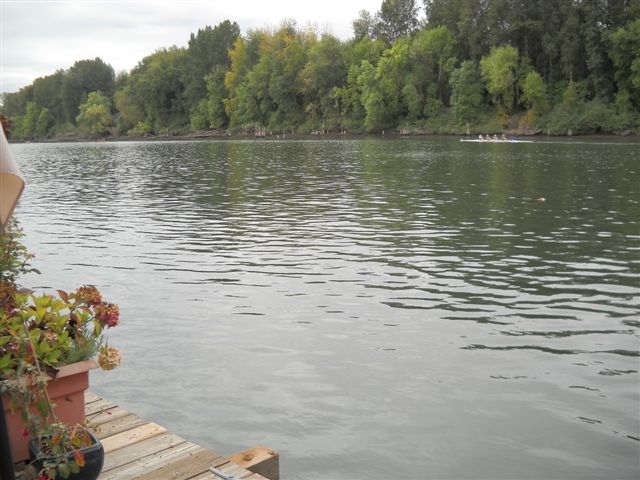
Monday, November 12, 2012

Shinrin-yoku


In the December 2012 issue of Outside magazine, there's a piece titled "Take Two Hours of Pine Forest and Call Me in the Morning: The Nature Cure." It's a story of how Japanese researchers are "backing up the surprising theory that nature can lower your blood pressure, fight off depression, beat back stress -- and even prevent cancer."

One of the philosophies is called shinrin-yoku, literally "forest-bathing, inspired by ancient Shinto and Buddhist practices, to let nature enter your body through all five senses.

Part of the piece are six sidebars of advice, "The Outside Rx," and one of them is GO BLUE. It says, "Greening our lives is a good start, but we need to blue them, too. New research suggests that water may be a key element in the natural world for psychological well-being." It goes on to say that "Similary, a 2010 review of the mental-health benefits of being outside concluded that any exposure to natural space improves mood but that proximity to water significantly magnifies the effect. The more blue you incorporate into your life, the less blue you may feel."

When I moved here, with a view of water out of every window, many people told me how calming it feels, and now it's fascinating to know that the benefits are more than any of us imagined.

"Soft fascination"

Another part of the piece describes research at the University of Michigan led by Rachel and Stephen Kaplan, who noted that modern-day psychological distress was often related to mental fatigue from sustained attention on tasks. What rests our brains? "Soft fascination" -- what happens when you watch a sunset or butterfly.

I realize that all my long paddles are "soft fascination" -- awareness of sights, sounds, smells without other distractions. I shall close down the computer and plan a paddle for tomorrow ...


... and John did a dive for the moonstone ring


This is a continuation of the "Mary fell in ....." post, and I am unlikely to ever have a more delightful living-on-the-river story.

After Mary put her sopping wet clothes in the dryer, she realized that while her glasses had not fallen off, her beautiful gold ring with a moonstone had!

It occurred to her that maybe John Glenn could dive down and try and find the ring. John Glenn is a profesionnal diver and houseboat expert. I'd hired him to do a dive inspection of my houseboat before I agreed to buy it, and he has done underwater work on many of my neighbors' floating homes.


Mary called John and left him a message and he called right back and arranged to meet her at 4:30 p.m. -- so he would be diving when it was dark above the river as well. He estimated that the river in the backwater there was about 25 to 30 feet deep.

John marked the spot with a long, heavy, pointed metal pole, then put on his wetsuit. Other neighbors gathered to watch. He dropped down underwater, and as he described later, was careful not to put his feet down, which would have stirred up the silt and covered everything. He hung onto the pole and shone a very bright light all around. About 7 feet upstream from where Mary fell in, he spotted the white stone glinting back. Within just 3 to 4 minutes, he came up holding Mary's ring!

Mary said, " I truly felt like I had called Superman and he came and conquered! And he wouldn't take a penny - said he hadn't done it for money, he wanted to help, and enjoyed it.'

Since John wouldn't take any money, Mary told him that she likes to cook for friends and could she cook him a dinner and if so, what would he want. John agreed to a dinner and asked for pot roast and lemon meringue pie. So last week, Mary invited John and another neighbor over to dinner, for thanks and a celebration.

(Photo of John in his wetsuit to come from Mary)

Later, John told me about someone at another moorage who lost a very expensive ring to the river. These folks tried to use a metal detector, which stirred up all the silt so the ring may be impossible to find. He suggested that what they might try now is to use a dredge to suck up the silt and then shake it through a screen.


Mary fell in ..........


GUEST BLOG -- by Mary Forst

This is a guest blog incorporating an email from my neighbor Mary Forst, who wrote on October 26, "I fell in the river today!"

Mary wrote:
" No kidding. I was just walking (okay, I was hurrying, but still) across to my tenderhouse, when I suddenly found myself toppling over to the right - away from my handrail - and knew I was going in! I went under face-first, but my feet were still on the boards, so I had a hard time getting my face out of the water. So I pulled my feet off and went in all the way - looked around to see if anyone was available to help - saw no-one, and started hauling myself out. It was amazingly hard to do.

"I started to go into my house but realized water was pouring off me. I took off my fleece jacket (boy, can that stuff hold water!) and shoes, slipped inside, stripped next to the washer and tossed everything but me and the shoes in. That's when I realized that while my glasses had not fallen off, my beautiful gold ring with moonstone had!
"Took a quick shower and of course the phone rang and the guy from Closets to Go arrived at the door that same instant.

"So now my clothes are washed and dried, and my ribs hurt when I laugh (I got an emergency chriropractor appointment tomorrow), I am so grateful to be alive.

"You just never know . . . everything can change in an instant."

_________________________________________________________________________________

The photos above and below show the narrow spot where Mary fell in. The "stripes" below are part of the reflection of her tenderhouse siding and window. I went out to look and see if I could fall between the walkway and my tenderhouse -- no, mine are closer together, but there are three railroad-type spikes stiking up and I'm not sure which would be less awful -- falling in the water or getting impaled on rusty spikes.


Wednesday, October 24, 2012

Alder Point Restoration Project


Alder Creek Lumber has been operating at the southern tip of Sauvie Island as long as I've lived here. Now some of its land has been sold and it's about to undergo a major restoration project as mitigation for the superfund sites at Portland Harbor -- a fine reminder that we are all downriver from the superfund sites.

According to a website of the Portland Harbor Natural Resource Trustee Ecological Restoration Portfolio (http://www.darrp.noaa.gov/northwest/portharbor/pdf/Restoration_Portfolio.pdf) it says  "Proposed restoration: Restoration efforts at this site could include regrading the river banks to create a shallower slope, increasing interaction between the river and the floodplain. Restoration could also include adding native vegetation to floodplain and upland areas. Additional restoration options could also include removing portions of the private levee and restoring a diversity of riparian, marsh, mud flat and off‐channel habitats across the site. Benefits: Off‐channel, shallow, slow moving waters provide refuge and productive foraging areas for lamprey and juvenile salmon. Shallow areas can also serve as important hunting areas for bald eagles, osprey, spotted sandpiper, mink and other species. Natural beaches serve as foraging areas for mink and staging areas for spotted sandpiper and other migratory birds. Regrading the shoreline will reconnect this area to its historic floodplain and encourage the use of off‐channel areas by fish. Adding native vegetation along the banks will improve habitat complexity, increase sediment retention, provide an invertebrate food source for fish and some wildlife, and create perching and nesting habitat for birds and other animals."

West Multnomah Soil & Water Conservation notes that Wildlands PNW is a for-profit corporation that is developing the "Alder Point Project" as a Harbor mitigation site.

The website for Wildlands is http://www.wildlandsinc.com/ although I don't see where it lists this project.

Last week at the Sauvie Island Community Association meeting, Michael Karnosh, the Ceded Lands Program Manager for the Confederated Tribes of the Grand Ronde, talked about this project when asked. (The Multnomah tribe that lived on Sauvie Island are recognized as part of the confederated tribes). He said they are on the Trustee Council and explained that "Portland Harbor needs cleanup because it's been damaging fish and wildlife. This is to compensate the public; a way to make the public 'whole' is to restore habitats."

I don't know how soon these lumber company structures will be gone, but I wanted to document them.

As I was paddling by on Sunday taking these photos, three mergasers flew off in front of me, and I spotted these two great blue herons (if you look closely at the last photo (or enlarge it) you can see one on the piling and one on shore -- a good omen, I thought, for what's to come.


Saturday, October 20, 2012

"The Dagney" and "The Labrador"

Part of my passion for my "Adventure Paddles" (see previous post) is going past some large, unusual craft upriver. I thought perhaps they were there for repairs. What I learned about the two largest was quite a surprise. 


The Dagney


What I have found so far about The Dagney is from this 2007 website: http://www.sneakywhale.com/point5.html. It's a 1904 fish tender from Juneau, Alaska that "Trub's" friend lives in. He notes that now the hull is encased in Ferro-cement. If I see the owner sometime when I paddle by I will surely be inquisitive to learn more of the craft's story.


The Labrador

Who would imagine this is an art gallery? It's called 12128 BoatSpace and once I discovered that I learned that some of my neighbors had heard about it and hadn't a clue where it was.  Here's a summary of the info I found at the FortPort website noted below: The Labrador is a WWII crabbing vessel from the Bering Sea. It's 135 feet long and weighs 200 tons. Kyle Thompson, Lewis Feuer, Caitlin Ducey, and Zoe Clark are the folks who maintain the ship and operate the gallery. The gallery has been hosting shows since May 2010 and photos and information of the works exhibited are on the website. I'm told the next exhibit will be in January, 2013. An artist was at work inside when I paddled by yesterday but it was too rainy and late in the day for me to stop and say hello and find out more -- but I will.

For more information and ship photos: http://www.fortport.com/?p=2604
To see exhibit photos, find out about past and upcoming shows or to get on the mailing list:
http://www.12128boatspace.com/location/

The ferries of NW Ferry Road


My moorage's address is NW Ferry Road and the the road dead-ends in a boat ramp. It began literally as a ferry road -- landing for a series of ferries that carried islanders to the mainland before a bridge was completed in 1950.

According to the history on these photos hanging on the wall in the island Grange building, Multnomah County began ferry service in 1910 across what was then called the Willamette Slough. The unnamed craft was described as "a slow box on water." Dewey Charlton began as a pilot in 1917 and continued until the ferries were discontinued.

It was replaced in 1919 by the Walter H. Evens, with a six-car capacity, which operated until 1932. The hours were listed as 5:30 a.m. to 1:00 a.m., except Mondays, from 6:30 a.m. to 7:00 p.m., and on Saturdays it ran all night. (When I get to the Oregon Historical Society I'll replace these with better photos.) It was guided by a trolley with a cable running through and ran in reverse on the return trip.


The third ferry was The Burlington, which operated from 1932 to 1945. This wooden-hulled boat had  its pilot house in the middle and a propeller at each end. An incident occurrred where a 35-ton crane was set incorrectly onto the deck and the ferry capsized (and was righted and in back in operation 11 hours later).


The last ferry was called The Sauvies Island and crossed the channel from 1945 to 1950. It was a steel ferry that carried 16 automobiles and averaged 200 trips a day.


According to The Story of Sauvies Island by Omar Spencer, before the county ferries were established, people traveled to and from the island by steamboat, towboats, and private ferries. Some of these were through-boats to Astoria, others carried a combination of passengers, freight and the occasional load of cattle.

Sunday, September 30, 2012

Head of the Dog Scull Regatta

    
            Crew with tiaras                                       Crew with cowboy hats

    
             Crew with wolf or dog hats                      Crew with prison stripes

I had house guests for the weekend and Saturday morning I was talking about how entertaining it is to live on the water. No kidding. On a typical day, amongst the craft going by are a few rowing sculls, coming from a boathouse just above the island bridge that belongs to a group called the Portland Boat Club.

This Saturday was an entertainment jackpot day. First, a couple of scullers came past. Then more. Then more. Then two-person sculls. Then more. Then more. Then four-person sculls. Then more. Then more. Then four-person sculls with coxswains (an extra person facing forward calling out directives). We also couldn't help but notice lots of them were wearing costumes: see above and below.

I, still in my pajamas, walked out on the deck and yelled out to a couple of guys in a double, asking them what was going on. They said it was a race, although they were headed downriver randomly and no one looked like they were racing.

After awhile they started coming back upriver, and this did look like a race -- moving in multiples and faster with seeming intent. I went out and started taking photos.

Today I looked on the web to see what this was about -- it seemed like every sculler in the Portland metropolitan area was rowing past. It was the Portland Boat Club's second annual HOTDog or Head of the Dog Regatta. It cost $20 a head. Here's a link to their website and some information about the group:

"About PBC

The Portland Boat Club is a group of dedicated rowers, mostly scullers, in Portland, Oregon. Up until 1994, we were the Portland Rowing Club, a revival of one of the oldest rowing clubs west of the Mississippi, but following a legal split from a houseboat moorage of that name, we are the Portland Boat Club. We offer our members the benefits of belonging to a competitive club. We offer camaraderie with a focus on improving sculling performance, use of club boats, as well as moorage for privately owned boats. The Portland Boat Club is a member club of USRowing."
 

            Solo sculler in blue suit and bow tie     More solo scullers


           Doubles                                              Quad avoiding barge and tug

            Three sets of quads                              Route relative to deck

Wednesday, September 26, 2012

Hronk! Hronk! Goose scratch! Hronk! Hronk!


This is a follow-up to the Hronk! Hronk! earlier post.

I did my duty and went to Linnton Feed and Seed to buy cracked corn, as I had read about on line, to feed the geese, instead of bread.

But when I got there, I saw there were two bins, cracked corn labeled "Hen Scratch" and another one with mostly white "pebbles" labeled "Poultry and Duck food." Both were 60 cents a pound. Huh?

So I went and asked the person at the counter. She told me that cracked corn is like candy -- a snack for the birds, and not very nutritious. The "pebbles" in the other bin are dried soybean milk, which has a lot of protein and nutrients and is better for the birds. Since they were both the same price, she offered to give me a mix of the two -- nutrition and a snack (not hard to convince a most-health-food conscious chocolaholic) and I bought eight pounds' worth. The other option was to buy a 50-pound bag of one or the other.

Now I've got my super-duper goose food but when they came hronking and I threw it in the water -- it mostly sank, and by the immediate splashes, I figured the carp were getting it. At one point a carp must have come up right below one of the geese who screeched and flapped his wings and hurried away.

Okay, now what? The geese would get a little bit of it, but most of it sank. Then I discovered that there were some depressions in my float logs below, and that I could put a couple of handfulls in two different places, so two birds could eat at one time. The one that is all white (I'm guessing that one's the male) is more aggressive than the other and unless they had separate spots, the bird with gray on its wings wouldn't get anything.

I thought I would have to make sure to rinse the wood off every day so as not to attract rats, but not only do the geese eat every morsel, I realize wakes from passing boats wash it off continually, too.

I've now had to buy my second eight pounds, and also bought a small plastic container so I could keep the feed on the deck. I don't think this batch is going to last that long. Before, this pair used to come by maybe once or twice a day. Now they come by hronking VERY LOUDLY four or five times a day. I am going to have to go back on line to find out how many ounces a goose ought to eat a day and feed them accordingly.

(By the way, I got the above photo only by waiting very patiently until the goose got comfortable with me and my camera leaning way over the deck.)


Mystery of the mudded golf balls


First I saw one, then a second one, then another one. As the river level got lower over the dry summer days and months, I would spot more golf balls along shore as I paddled. Most of them were across from Bridgeview Moorage. I didn't know enough about golf to imagine someone could be driving balls from clear across the channel. Was someone up above on the dike playing golf? That notion seemed a crazy irony, since I was one of a gang of rabble-rousers who had stopped the development of a tournament golf course on the island in 1989.

I could not resist collecting each and every one that I saw. Some are white, some are yellow. Most of them I was able to pry out of the mud with my paddle, but a few were far enough from the water that I had to get out and squish through the mud.

I started asking people and learned that yes, a number of houseboaters -- including my neighbors two doors away -- do in fact drive golf balls off their decks for amusement. Were these golf balls worth anything? This neighbor pays his grandchildren 10 cents for each one they find when he takes them across the channel in his boat for golf-ball hunts. He offered me the same 10 cents for mine.

One day -- the jackpot day -- I found 13. I now have a total of 28. I thought my hard-pried collection was worth more to me than $2.80 so I have kept them.

A few weeks ago I bought a copy of The Houseboat Book by Barbara Flanagan. It looked quite wonderful, and besides, one of the houses in it is my neighbors'. Portland was one of the places where the author did a lot of research because, it turns out, Portland has more houseboats than anywhere in North America (pg. 146).

I almost rolled on the floor laughing when I read this description on page 76: "In Portland, Ron Schmidt has three platforms... on the deck, Schmidt has installed a patch of artificial turf to help him drive used golf balls across the river." Was a certain Ron Schmidt the originator of most of my golf balls? I googled him and discovered he lives at a different moorage at least 10 miles away.

I could email my friends who live at Bridgeview Moorage to ask who might have driven all these golf balls I unearthed, but I think I won't -- it will be more fun to learn some day serendipitously.

In the meantime, the river has gone even lower and I've not found a single other golf ball since the jackpot day a few weeks ago.

Not only is there a mystery golfer -- what causes the golf balls to land and stay stuck along just a few waterlines along shore and nowhere else?


UPDATE: As of October 19, 2012, I have thus far found 54 golf balls -- 11 yesterday.

Pocket your keys


One of the first bits of advice to a new houseboater is to pocket your keys. You are admonished not to hold keys in your hand while going down the ramp or along the walkway -- because it is far too easy to stop to talk to someone, or juggle your packages, or any little thing that takes away your attention -- and before you know it, your keys have fallen out of your hand and gone into the drink, nevermore to be seen.

Even the keys attached to a float, like that above, were lost -- I found them bobbing alongside my kayak one day when I was paddling.

So, from the get-go I have been extremely conscientious about not just putting keys in my pocket, but zipping them in my purse -- so they don't fall out if my purse gets lop-sided on my shoulder, or wiggles in the open-grid cart. Even when I go up to check the mail, I take a small shoulder bag and zip the mailbox key inside. This also gives me a place to put my mail so bills and letters don't blow away in the breeze as I'm walking back.

The next thing is to be sure to warn all your guests to put their keys in pocket or purse, lest they lose them to the river and not be able to even drive their cars to get home -- resulting, of course, in less than fond thoughts toward again visiting their riverhouse friends.

I ought'r see more otters


Phoo! I have been here nearly a year and have seen only one river otter -- and that one in quick passing outside my office window. I hear other neighbors talk about seeing them regularly. Sometimes I will be outside on the deck talking to a long-time houseboater who will hear the sound of the otters playing under my logs, or my neighbor's logs, but I can't recognize what they hear. Even if I did -- I want to see the otters, not just hear them. I love their playfulness in the water and scampering ways on land. I frequently hear and/or see the beaver who lives in the creek inlet across the way -- the beaver will splash its tail in warning when I get near and sometimes I get a glimpse of it. But not so for the elusive otters. I hope over time to see more -- lots more -- of them.

                                          Photo credit: Robert Barber/Painet Inc.

Thursday, September 13, 2012

The first cormorant of autumn


art by Daurie Mangan-Dimuzio


I have to say I'm not an expert birder. But I also have to say that the birds I know, I KNOW.  Great blue heron -- check. Redwing blackbird -- yep. Belted kingfisher -- sure. American goldfinch --absolutely. So today I was not at all uncertain that I saw the first cormorant of autumn as I was paddling, just upriver of the last houseboat. I was elated.

When I moved here in November, cormorants were the birds I saw most often, landing and swimming in the waters outside my window, or lined up across the river on logs along the riverbank. This is their wintering range, but when they left in spring to nest, it was so imperceptible that I didn't notice it until they were all gone. Then I really missed them.

Where did they go? I wondered today. The Audubon Bird Encyclopedia says that their nesting range (they nest April through July) is along the Pacific coast from the Aleutians to s. Baja California.

In National Geographic's Field Guide to Birds of America, it shows our area as the winter range, the coast as the year-round range, and the breeding range (I have to look with a magnifying glass to make it out) appears to be northeastern Oregon and south central Oregon.

I think I recall river people saying "our birds" go to the Oregon coast, so I will ask around to find out more.They nest on rocky coasts, and that is certainly the Oregon coast. These are double-crested cormorants, which are the only cormorants likely to be seen inland around rivers. One of their most noticeable behaviors is to hold out their wings to dry in the sun (because unlike ducks, their wings are not completely weatherproof).

Welcome back, Phalacrocorax auritus. Good to see you here again.

Added on September 26:
I have now seen 17 cormorants. Mostly singles, except the three below flying off, that were together on a log. The one on the piling is the "classic" way we see them. I have seen only two flying past my houseboat -- I am looking forward to seeing them regularly out my windows like I did all last winter.


Added on December 4:
Yesterday, directly across from me, on a wooden structure lodged in the mud, sat 28 cormorants. I counted them through my spotting scope and watched as they spread their wings to dry. Right now I see three, accompanied by a heron, and two more in the water.


Tuesday, September 11, 2012

A tenderhouse by any other name


Oh, to be a wordsmith and own something known by a name that's not in the dictionary or encyclopedia. How can that be?

Over the last two months I hosted two Open Houses, taking more than 60 friends and neighbors on a tour of my new place, and when I would get to the tenderhouse -- a floating shed on the opposite side of the walkway -- and say, blah, blah, and this is the tenderhouse, inevitably people would ask "The what?" or "Where did that name come from?"

Being a wordsmith, of course I eventually got around to looking it up.
But to my disbelief ...
Neither tenderhouse nor tender house is in the Merriam-Webster dictionary.
Nor in the Encyclopedia Brittanica.
Nor, oddly enough, could I find a definition via Google searching through a multitude of combinations of words.

A tender, of course, is a small boat that tends to a larger ship. Or, as Merriam says, ""A ship employed to attend other ships (as to supply provisions)" and "a boat or small steamer for communications between shore and a larger ship." But that's not what our tenderhouses are.

If I just googled "tenderhouse" I would get a ton of links to a website called tenderhouse.com written in a language that looked eastern European.
If I googled "tenderhouse""floating home" I would get a bunch of real estate ads for floating homes on sale, and it would give the dimensions of the tenderhouse included in the sale.
I tried "tender's house." I tried "tenderhouse" "Floating" and what all else I can't recall.  

Finally, I got to a county document of regulations that included "Chapter 15.16 Moorages and floating structures code."
In the list of definitions was this:
"Tender house means a noninhabitable, floating accessory building."

Some day I shall come upon a proper source.


Thursday, September 6, 2012

Dancing light


It's like one's own aurora borealis. Well, only one color -- white -- but the reflective rippling on the walls and ceilings is something I've always found magical, at friends' houseboats long before I had my own.

This past week has been especially wondrous, with sunny days full of bright light and wind to ripple the surface of the water. There's been a full moon, too, and through the night the light ripples brilliantly across the ceiling.